The System Rider
Ethiopia's government already distributed fertilizer to 250,000 smallholder farmers. WFP didn't build new insurance infrastructure — it added a policy to the voucher. Coverage scaled 12-fold in two years.
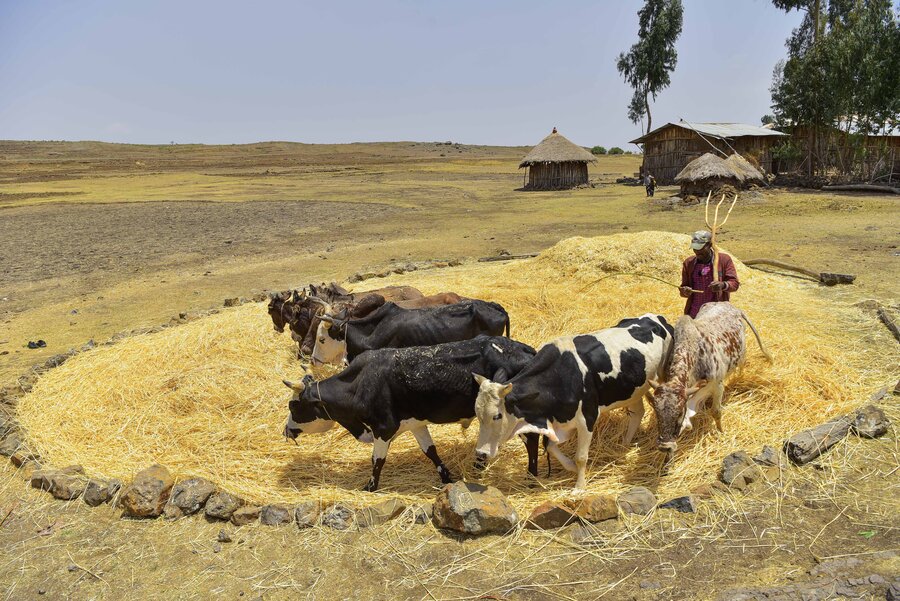
Photo: World Food Programme (WFP)
Traditional crop insurance fails smallholders — last-mile distribution costs more than premiums cover. WFP's fix: bundle coverage with existing government programs. In Ethiopia, WFP added Area Yield Index Insurance to the government's Input Voucher System — already reaching millions of farmers — growing coverage from 20,000 households in 2022 to nearly 250,000 by 2024. Zambia embedded similar coverage in its Farmer Input Support Programme, reaching over 1 million farmers.
The second shift is timing. WFP's Forecast Index Insurance triggers payouts before crops fail — climate models replace loss adjusters. In Ethiopia's 2023 Meher season, 52,000 farmers received 39 million birr before full crop failure materialized. Cuba's enrolled farmers cut crop losses from 15% to 7%; 80% reduced vulnerability scores within two years.
Cuba adds a self-reinforcing loop: premium discounts tied to a 28-indicator vulnerability score create demand for resilient farming. CGAP's April 2026 four-country study finds that embedding insurance in government programs lowers costs and increases uptake at scale. No new infrastructure — only a government willing to add a rider to what it already funds.
Our take
Agricultural insurance for smallholders fails on distribution: building parallel last-mile infrastructure costs more than premiums cover. WFP's four-country demonstration proves the fix — embed coverage into existing government input programs and use forecast triggers instead of loss adjusters. Ethiopia scaled 12-fold in two years without building any new infrastructure. The shift for agriculture ministers: any country running an input subsidy already has the delivery channel for mass smallholder insurance. The question isn't 'how to build it' — it's 'which line item to add the rider to.'
What to do with this
Add an insurance rider to your existing input voucher or subsidy program. WFP and insurtechs like Pula Advisors provide the technical design at no upfront infrastructure cost. Ethiopia went from 20,000 to 250,000 insured households in two years through its fertilizer distribution channel alone — no new offices, agents, or enrollment systems required.
Fund the market-shaping layer — WFP's role as system integrator — not standalone insurance pilots. Government distribution drives uptake at near-zero marginal cost, so every dollar into the design and risk-transfer layer goes further than building parallel channels. Ask partners: which government program are you embedding in?
Price risk-reduction incentives into smallholder products. Cuba's 28-indicator vulnerability matrix links premiums to farm-level resilience practices, creating a portfolio that gets cheaper as farmers de-risk. The data is already in government agricultural registries — you don't need to collect it yourself.
Treat forecast-based index insurance as a complement to cash transfer programs, not a replacement. When governments already run conditional cash or input subsidy schemes, adding forecast-triggered insurance payouts costs less than building a parallel anticipatory action fund — and it survives budget cycles because farmers pay premiums, not just receive grants.
Go deeper
Daily intelligence
One named innovation per day. Free.
Sourced across health, climate, education, governance, and more — delivered in 2 minutes.