Village-First Solar
Indonesia gets 1.7% of its electricity from solar — less capacity than China installs in a week. Its answer: skip the grid entirely and deploy 80 GW across 80,000 village cooperatives at $78 billion.
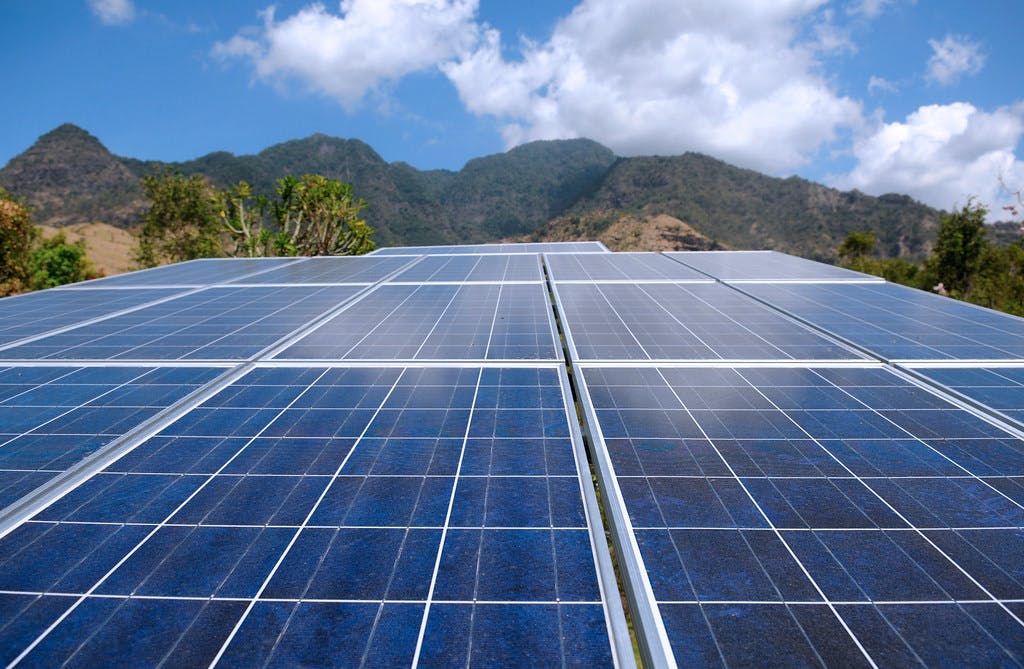
Photo: Eco-Business
Indonesia burns $2 billion a year on diesel imports to power remote islands. Its solar capacity — 1.49 GW — is less than what China adds in a single week. The fourth-most-populous nation gets 36% of its electricity from coal and 1.7% from solar.
The government's plan skips the grid entirely. Of a 100 GW target, 80 GW would deploy as solar-plus-battery systems across 80,000 villages — roughly 1 MW each, owned and operated by village cooperatives, not the state utility PLN. Total cost: $78 billion. The architecture treats Indonesia's 17,000-island geography as a feature, not a bug.
The obstacles are real. PLN has signed zero power purchase agreements despite a 180-day mandate. The cooperatives lack technical capacity. The country needs 100,000 trained installers who don't exist yet. But the geopolitical math is forcing action: Middle East instability threatens oil supply, and village-scale solar could eliminate the diesel dependency that makes remote communities most vulnerable.
Our take
This is an infrastructure-routing innovation, not an energy target. The 100 GW headline is probably unrealistic, but the delivery architecture — bypassing the state utility entirely in favor of village cooperatives owning 1 MW systems — rewrites how archipelago nations can electrify. If even 10% lands, it's the largest distributed solar deployment ever attempted. Climate funders should stop waiting for PLN grid reform and start funding cooperative technical capacity directly.
What to do with this
Fund installer training programs and cooperative management capacity now — Indonesia needs 100,000 trained technicians who don't yet exist. The hardware is commodity; the human infrastructure is the binding constraint.
Mandate PLN sign power purchase agreements within 90 days. The current 180-day window has produced zero PPAs — without grid interconnection deals, 80,000 village systems become stranded assets generating power with nowhere to sell it.
Pilot the village cooperative model in the Philippines, Papua New Guinea, or Pacific Islands this year. These nations share Indonesia's grid bottleneck — distributed ownership may be the only architecture that works for archipelago electrification.
Go deeper
Daily intelligence
One named innovation per day. Free.
Sourced across health, climate, education, governance, and more — delivered in 2 minutes.