The Rising Foundation
In Bangladesh, 20% of the land floods every year. A University of Dundee team built a house that doesn't fight the water — it rises with it, then settles back when the flood recedes.
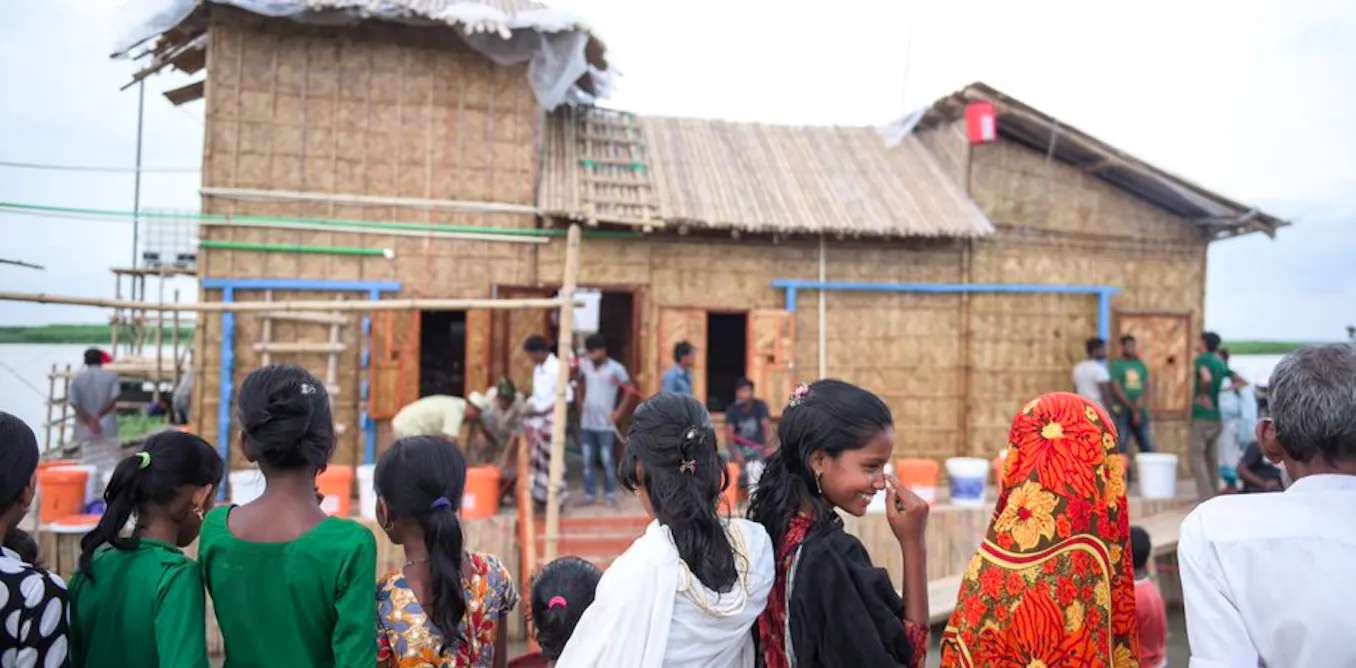
Photo: The Conversation
Every monsoon, roughly a quarter of Bangladesh goes underwater. The standard response — evacuation, emergency shelters, rebuilding — cycles annually for 30 million people. A University of Dundee researcher asked a different question: what if the house just floated?
The answer is Swapner Bari (House of Dreams), on Dhaka's Balu River. A 40-tonne buoyant platform rises along four anchored guideposts as floods arrive, then settles when waters recede — no evacuation required. Earth block walls hold the interior at 26°C while cutting carbon emissions 75% versus conventional brick. The full system — rainwater harvesting, aquaponics, 5 kW solar — fits a one-bedroom unit at $4,000, half the per-square-foot cost of a conventional Bangladeshi home.
The project won the UN Risk Award in 2019, is now in its third phase backed by the Munich Re Foundation and Scottish Government, and has spawned parallel pilots in Vietnam's Mekong Delta and Kerala. The prototype works. The question now is whether building codes and housing finance will catch up to the physics.
Our take
This is localized adaptation at its most literal: instead of engineering against water, the house cooperates with it. The buoyant platform turns flooding from a catastrophe into a mechanical event — the home rises, the family stays. The shift matters because 45 million Bangladeshis live in extreme cyclone zones, and evacuation-based models fail repeatedly. When the cheapest climate-resilient house is also the cheapest house, period, adaptation stops being a premium product and becomes the default.
What to do with this
Fund amphibious retrofitting pilots in flood-prone deltas beyond Bangladesh — the Mekong, Niger, and Ganges-Brahmaputra deltas face identical conditions
Integrate buoyant-platform standards into building codes for flood-prone zones, starting with new construction in riverine areas
Shift shelter budgets from post-flood emergency response toward pre-flood amphibious housing that eliminates the need for evacuation
Go deeper
Daily intelligence
One named innovation per day. Free.
Sourced across health, climate, education, governance, and more — delivered in 2 minutes.